الرئيسية الكورسات الرياضيات كورس Mathematics (All Of It) من الصفر باللغة العربية

كورس Mathematics (All Of It) من الصفر باللغة العربية

👤 Professor Dave Explains 🎬 193 درس ⏱️ 25 ساعة 57 دقيقة 📶 مبتدئ 🇪🇬 عربي
Introduction to Mathematics
📋 محتوى الكورس 193 درس · 25 ساعة 57 دقيقة
  • 1 Introduction to Mathematics 6:44
  • 2 Addition and Subtraction of Small Numbers 8:39
  • 3 Multiplication and Division of Small Numbers 6:20
  • 4 Understanding Fractions, Improper Fractions, and Mixed Numbers 6:13
  • 5 Large Whole Numbers: Place Values and Estimating 4:29
  • 6 Decimals: Notation and Operations 4:21
  • 7 Working With Percentages 3:36
  • 8 Converting Between Fractions, Decimals, and Percentages 5:21
  • 9 Addition and Subtraction of Large Numbers 5:57
  • 10 The Distributive Property for Arithmetic 3:19
  • 11 Multiplication of Large Numbers 6:28
  • 12 Division of Large Numbers: Long Division 5:41
  • 13 Negative Numbers 5:27
  • 14 Understanding Exponents and Their Operations 8:42
  • 15 Order of Arithmetic Operations: PEMDAS 4:22
  • 16 Divisibility, Prime Numbers, and Prime Factorization 5:54
  • 17 Least Common Multiple (LCM) 5:40
  • 18 Greatest Common Factor (GCF) 4:46
  • 19 Addition and Subtraction of Fractions 4:07
  • 20 Multiplication and Division of Fractions 5:06
  • 21 Analyzing Sets of Data: Range, Mean, Median, and Mode 5:46
  • 22 Introduction to Algebra: Using Variables 4:04
  • 23 Basic Number Properties for Algebra 5:16
  • 24 Algebraic Equations and Their Solutions 4:52
  • 25 Algebraic Equations With Variables on Both Sides 6:46
  • 26 Algebraic Word Problems 5:38
  • 27 Solving Algebraic Inequalities 5:43
  • 28 Square Roots, Cube Roots, and Other Roots 9:02
  • 29 Simplifying Expressions With Roots and Exponents 8:23
  • 30 Solving Algebraic Equations With Roots and Exponents 5:46
  • 31 Introduction to Polynomials 5:13
  • 32 Adding and Subtracting Polynomials 5:32
  • 33 Multiplying Binomials by the FOIL Method 6:25
  • 34 Solving Quadratics by Factoring 9:37
  • 35 Solving Quadratics by Completing the Square 7:32
  • 36 Solving Quadratics by Using the Quadratic Formula 6:55
  • 37 Solving Higher-Degree Polynomials by Synthetic Division and the Rational Roots Test 9:22
  • 38 Manipulating Rational Expressions: Simplification and Operations 9:30
  • 39 Graphing in Algebra: Ordered Pairs and the Coordinate Plane 6:56
  • 40 Graphing Lines in Algebra: Understanding Slopes and Y-Intercepts 6:52
  • 41 Graphing Lines in Slope-Intercept Form (y = mx + b) 5:06
  • 42 Graphing Lines in Standard Form (ax + by = c) 5:33
  • 43 Graphing Parallel and Perpendicular Lines 4:47
  • 44 Solving Systems of Two Equations and Two Unknowns: Graphing, Substitution, and Elimination 10:21
  • 45 Absolute Values: Defining, Calculating, and Graphing 5:10
  • 46 What are the Types of Numbers? Real vs. Imaginary, Rational vs. Irrational 9:00
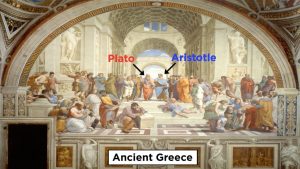
  • 47 Introduction to Geometry: Ancient Greece and the Pythagoreans 4:00
  • 48 Basic Euclidean Geometry: Points, Lines, and Planes 4:19
  • 49 Types of Angles and Angle Relationships 7:24
  • 50 Types of Triangles in Euclidean Geometry 5:25
  • 51 Proving Triangle Congruence and Similarity 5:08
  • 52 Special Lines in Triangles: Bisectors, Medians, and Altitudes 6:20
  • 53 The Triangle Midsegment Theorem 3:08
  • 54 The Pythagorean Theorem 5:02
  • 55 Types of Quadrilaterals and Other Polygons 6:17
  • 56 Calculating the Perimeter of Polygons 5:08
  • 57 Circles: Radius, Diameter, Chords, Circumference, and Sectors 4:58
  • 58 Calculating the Area of Shapes 6:39
  • 59 Proving the Pythagorean Theorem 3:34
  • 60 Three-Dimensional Shapes Part 1: Types, Calculating Surface Area 7:32
  • 61 Three-Dimensional Shapes Part 2: Calculating Volume 6:17
  • 62 Back to Algebra: What are Functions? 7:23
  • 63 Manipulating Functions Algebraically and Evaluating Composite Functions 5:29
  • 64 Graphing Algebraic Functions: Domain and Range, Maxima and Minima 5:54
  • 65 Transforming Algebraic Functions: Shifting, Stretching, and Reflecting 7:52
  • 66 Continuous, Discontinuous, and Piecewise Functions 5:18
  • 67 Inverse Functions 6:29
  • 68 The Distance Formula: Finding the Distance Between Two Points 3:38
  • 69 Graphing Conic Sections Part 1: Circles 7:46
  • 70 Graphing Conic Sections Part 2: Ellipses 6:33
  • 71 Graphing Conic Sections Part 3: Parabolas in Standard Form 8:30
  • 72 Graphing Conic Sections Part 4: Hyperbolas 5:58
  • 73 Graphing Higher-Degree Polynomials: The Leading Coefficient Test and Finding Zeros 9:15
  • 74 Graphing Rational Functions and Their Asymptotes 7:24
  • 75 Solving and Graphing Polynomial and Rational Inequalities 7:34
  • 76 Evaluating and Graphing Exponential Functions 5:59
  • 77 Logarithms Part 1: Evaluation of Logs and Graphing Logarithmic Functions 8:10
  • 78 Logarithms Part 2: Base Ten Logs, Natural Logs, and the Change-Of-Base Property 6:26
  • 79 Logarithms Part 3: Properties of Logs, Expanding Logarithmic Expressions 7:06
  • 80 Solving Exponential and Logarithmic Equations 7:08
  • 81 Complex Numbers: Operations, Complex Conjugates, and the Linear Factorization Theorem 8:35
  • 82 Set Theory: Types of Sets, Unions and Intersections 6:22
  • 83 Sequences, Factorials, and Summation Notation 11:12
  • 84 Theoretical Probability, Permutations and Combinations 15:52
  • 85 Introduction to Trigonometry: Angles and Radians 6:27
  • 86 Trigonometric Functions: Sine, Cosine, Tangent, Cosecant, Secant, and Cotangent 7:18
  • 87 The Easiest Way to Memorize the Trigonometric Unit Circle 9:48
  • 88 Basic Trigonometric Identities: Pythagorean Identities and Cofunction Identities 5:25
  • 89 Graphing Trigonometric Functions 11:40
  • 90 Inverse Trigonometric Functions 6:54
  • 91 Verifying Trigonometric Identities 9:14
  • 92 Formulas for Trigonometric Functions: Sum/Difference, Double/Half-Angle, Prod-to-Sum/Sum-to-Prod 9:29
  • 93 Solving Trigonometric Equations 8:28
  • 94 The Law of Sines 5:14
  • 95 The Law of Cosines 4:38
  • 96 Polar Coordinates and Graphing Polar Equations 10:46
  • 97 Parametric Equations 4:36
  • 98 Introduction to Calculus: The Greeks, Newton, and Leibniz 8:40
  • 99 Understanding Differentiation Part 1: The Slope of a Tangent Line 5:29
  • 100 Understanding Differentiation Part 2: Rates of Change 5:31
  • 101 Limits and Limit Laws in Calculus 12:49
  • 102 What is a Derivative? Deriving the Power Rule 10:05
  • 103 Derivatives of Polynomial Functions: Power Rule, Product Rule, and Quotient Rule 11:53
  • 104 Derivatives of Trigonometric Functions 7:57
  • 105 Derivatives of Composite Functions: The Chain Rule 12:29
  • 106 Derivatives of Logarithmic and Exponential Functions 8:41
  • 107 Implicit Differentiation 11:45
  • 108 Higher Derivatives and Their Applications 7:29
  • 109 Related Rates in Calculus 8:53
  • 110 Finding Local Maxima and Minima by Differentiation 6:17
  • 111 Graphing Functions and Their Derivatives 13:06
  • 112 Optimization Problems in Calculus 10:55
  • 113 Understanding Limits and L'Hospital's Rule 9:12
  • 114 What is Integration? Finding the Area Under a Curve 8:18
  • 115 The Fundamental Theorem of Calculus: Redefining Integration 9:38
  • 116 Properties of Integrals and Evaluating Definite Integrals 9:48
  • 117 Evaluating Indefinite Integrals 10:44
  • 118 Evaluating Integrals With Trigonometric Functions 7:32
  • 119 Integration Using The Substitution Rule 10:40
  • 120 Integration By Parts 13:17
  • 121 Integration By Trigonometric Substitution 15:55
  • 122 Advanced Strategy for Integration in Calculus 16:13
  • 123 Evaluating Improper Integrals 12:24
  • 124 Finding the Area Between Two Curves by Integration 7:52
  • 125 Calculating the Volume of a Solid of Revolution by Integration 11:20
  • 126 Calculating Volume by Cylindrical Shells 7:40
  • 127 The Mean Value Theorem For Integrals: Average Value of a Function 7:24
  • 128 Convergence and Divergence: The Return of Sequences and Series 9:40
  • 129 Estimating Sums Using the Integral Test and Comparison Test 9:56
  • 130 Alternating Series, Types of Convergence, and the Ratio Test 12:08
  • 131 Power Series 6:48
  • 132 Taylor and Maclaurin Series 9:34
  • 133 Hyperbolic Functions: Definitions, Identities, Derivatives, and Inverses 7:34
  • 134 Three-Dimensional Coordinates and the Right-Hand Rule 6:41
  • 135 Introduction to Vectors and Their Operations 10:17
  • 136 The Vector Dot Product 6:59
  • 137 Introduction to Linear Algebra: Systems of Linear Equations 10:46
  • 138 Understanding Matrices and Matrix Notation 5:26
  • 139 Manipulating Matrices: Elementary Row Operations and Gauss-Jordan Elimination 10:36
  • 140 Types of Matrices and Matrix Addition 6:46
  • 141 Matrix Multiplication and Associated Properties 6:22
  • 142 Evaluating the Determinant of a Matrix 7:09
  • 143 The Vector Cross Product 6:46
  • 144 Inverse Matrices and Their Properties 12:00
  • 145 Solving Systems Using Cramer's Rule 7:43
  • 146 Understanding Vector Spaces 8:41
  • 147 Subspaces and Span 5:50
  • 148 Linear Independence 12:56
  • 149 Basis and Dimension 10:06
  • 150 Change of Basis 9:34
  • 151 Linear Transformations on Vector Spaces 9:11
  • 152 Image and Kernel 5:35
  • 153 Orthogonality and Orthonormality 11:48
  • 154 The Gram-Schmidt Process 10:07
  • 155 Finding Eigenvalues and Eigenvectors 17:10
  • 156 Diagonalization 8:43
  • 157 Complex, Hermitian, and Unitary Matrices 9:00
  • 158 Further Matrix Decompositions: LU, Cholesky, QR, and SVD 10:10
  • 159 Double and Triple Integrals 15:29
  • 160 Partial Derivatives and the Gradient of a Function 10:57
  • 161 Vector Fields, Divergence, and Curl 15:36
  • 162 Evaluating Line Integrals 12:54
  • 163 Green's Theorem 6:37
  • 164 Evaluating Surface Integrals 12:24
  • 165 Stokes's Theorem 8:11
  • 166 The Divergence Theorem 6:31
  • 167 Introduction to Differential Equations 4:34
  • 168 Classification of Differential Equations 7:33
  • 169 Separable First-Order Differential Equations 7:05
  • 170 Linear First-Order Differential Equations 4:46
  • 171 Exact First-Order Differential Equations 8:45
  • 172 Homogeneous Differential Equations and Bernoulli Differential Equations 10:20
  • 173 Linear Second-Order Differential Equations Part 1: Homogeneous Case 10:20
  • 174 Linear Second-Order Differential Equations Part 2: Non-Homogeneous Differential Equations 10:18
  • 175 Special Second-Order Differential Equations: Cauchy-Euler, Nonlinear, and More 9:37
  • 176 Numerical Methods for Solving Differential Equations 8:30
  • 177 Power Series Solutions Part 1: Leibniz Method 10:33
  • 178 Power Series Solutions Part 2: Frobenius Method 9:24
  • 179 Systems of Differential Equations Part 1: Modeling and Elimination 7:50
  • 180 Systems of Differential Equations Part 2: Matrices and Stability 11:50
  • 181 Laplace Transforms Part 1: Solving Differential Equations 7:58
  • 182 Laplace Transforms Part 2: Convolutions and LTI Systems 14:59
  • 183 Difference Equations and Z-Transforms 10:34
  • 184 Introduction to Partial Differential Equations: Classification and Differential Operators 10:56
  • 185 Quasi-Linear First-Order Partial Differential Equations: Lagrange’s Method 8:14
  • 186 Laplace’s Equation: Separation of Variables 11:04
  • 187 Fourier Series and Transforms Part 1: Concepts in Frequency Analysis 11:02
  • 188 Fourier Series and Transforms Part 2: Power Spectra and K-Space 6:38
  • 189 The Wave Equation Part 1: Vibrations in 1D 10:15
  • 190 The Wave Equation Part 2: Multidimensional Waves and Dispersion 8:20
  • 191 The Diffusion Equation Part 1: Separation of Variables 6:52
  • 192 The Diffusion Equation Part 2: Dimensional Analysis and Self-Similarity 10:59
  • 193 The Diffusion Equation Part 3: Green’s Functions 8:42
▶ يُشغَّل الآن
Introduction to Mathematics

📘 نظرة عامة على الكورس

يُقدّم هذا الكورس المجاني شرحاً شاملاً لـ Mathematics (All Of It) من الصفر باللغة العربية في مجال الرياضيات، ويستهدف المبتدئين الراغبين في بناء مهاراتهم العملية واحترافية في 2026. يُقدّمه Professor Dave Explains باللغة العربية بأسلوب مبسّط ومنظّم.

يضم الكورس 193 درساً بمدة إجمالية 25 ساعة 57 دقيقة، تأخذك من الصفر حتى الاحتراف خطوةً بخطوة.

لماذا تتعلم Mathematics (All Of It) من الصفر باللغة العربية؟

  • الرياضيات أساس كل التخصصات العلمية والتقنية، وإتقانها يفتح أبواباً في AI والبيانات والمالية.
  • مجاني بالكامل — ابدأ الآن دون أي رسوم
  • شهادة إتمام معتمدة — أضفها لـ CV وLinkedIn
  • تعلّم في أي وقت — بالسرعة التي تناسبك
  • كل خوارزميات AI والتعلم الآلي مبنية على الجبر الخطي والإحصاء والتفاضل.

مسار التعلم في هذا الكورس

يسير الكورس وفق مسار منطقي متدرّج: الجبر الأساسي → الهندسة → التفاضل والتكامل → الجبر الخطي → الإحصاء → الرياضيات التطبيقية

المتطلبات السابقة

لا يحتاج خبرة مسبقة (للمستوى الأساسي) — يمكن لأي شخص البدء في هذا الكورس.

الأدوات والبرامج المستخدمة

  • MATLAB
  • Python (NumPy/SciPy)
  • Wolfram Alpha
  • GeoGebra
  • Excel

متطلبات الجهاز

  • أي جهاز
  • آلة حاسبة علمية

الوظائف المتاحة بعد إتمام الكورس

  • Data Scientist
  • Actuary
  • Quantitative Analyst
  • مدرس رياضيات
  • AI Researcher

متوسط رواتب Mathematics (All Of It) من الصفر باللغة العربية 2026

  • مصر: 5,000-20,000 ج
  • أمريكا (Actuary): $100,000-$180,000

كم من الوقت تحتاج لإتقان Mathematics (All Of It) من الصفر باللغة العربية؟

  • رياضيات ثانوي: 50-100 ساعة
  • رياضيات جامعي: 200+ ساعة

الشهادات المعتمدة في مجال الرياضيات

  • A-Level Mathematics
  • SAT Math
  • GRE Quantitative
  • CFA (رياضيات مالية)

مشاريع عملية ستتمكن من بناؤها

  • نماذج إحصائية
  • حل مسائل تحديات رياضية
  • نماذج AI

ماذا بعد هذا الكورس؟

بعد إتمام الكورس، يُوصى بالتعمق في: Data Science، Machine Learning، الفيزياء الرياضية.

الأقسام الجامعية ذات الصلة

يُناسب هذا الكورس طلاب: كلية العلوم (رياضيات)، كلية هندسة، كلية حاسبات.

سجّل في كورس Mathematics (All Of It) من الصفر باللغة العربية الآن، ابدأ رحلتك نحو الاحتراف في الرياضيات مجاناً. تذكّر: أفضل وقت للتعلم هو الآن.

P
المدرّس / القناة
Professor Dave Explains
🎬
عدد الدروس
193 درس
⏱️
المدة الإجمالية
25 ساعة 57 دقيقة
📶
المستوى
مبتدئ
🌍
اللغة
العربية
🎓
الشهادة
مجانية عند الإكمال
المتطلبات
لا توجد متطلبات مسبقة
📂
التصنيف
الرياضيات

🎯 ماذا ستتعلم في هذا الكورس

Introduction to Mathematics
Addition and Subtraction of Small Numbers
Multiplication and Division of Small Numbers
Understanding Fractions, Improper Fractions, and Mixed Numbers
Large Whole Numbers: Place Values and Estimating
Decimals: Notation and Operations
Working With Percentages
Converting Between Fractions, Decimals, and Percentages
+ 185 موضوع آخر...

💼 الوظائف التي يؤهلك لها الكورس

💼
متعلق بـ الرياضيات

❓ أسئلة شائعة عن الكورس

كم عدد دروس الكورس؟ +
يحتوي الكورس على 193 درس بإجمالي مدة 25 ساعة 57 دقيقة.
هل الكورس مجاني بالكامل؟ +
نعم، الكورس مجاني تماماً ومتاح بالكامل على منصة مصر 24 بدون أي رسوم.
هل الكورس مناسب للمبتدئين؟ +
الكورس موجّه لمستوى مبتدئ، وهو مناسب تماماً للمبتدئين من الصفر.
ما لغة الشرح في الكورس؟ +
الكورس مشروح باللغة العربية بأسلوب واضح ومبسّط.
هل يمكن تعلم الكورس بدون خبرة سابقة؟ +
نعم بالتأكيد. هذا الكورس مصمم للمبتدئين من الصفر.
كم يستغرق إتمام هذا الكورس؟ +
المدة الإجمالية 25 ساعة 57 دقيقة. يُنصح بتخصيص ساعة يومياً.
هل أحصل على شهادة عند الإتمام؟ +
نعم، تحصل على شهادة إتمام مجانية من مصر 24 بعد مشاهدة جميع الدروس.
من يقدم هذا الكورس؟ +
الكورس مقدم من Professor Dave Explains.
مواقيت الصلاة Au سعر الذهب سعر الدولار درجة الحرارة
🔐
نسيت كلمة المرور؟